


How to Choose Artistic Coffee Mugs for Your Home

Last Updated: November 2, 2026
Quick Summary
Choose artistic coffee mugs by matching capacity to how you actually drink, since most artistic mugs fall between six and fourteen ounces. Then check rim, handle, and base comfort, and confirm the glaze and decoration are fired into the clay for durability.
Match the mug to the pour: 10-12 ounces suits standard drip coffee and cappuccinos.
Slide two fingers through the handle to confirm a comfortable grip.
Run a fingertip around the rim; any roughness will annoy you daily.
A glossy decal applied over a plain mug can peel or fade with washing.
Underglaze decoration, where artwork sits beneath the glaze, is generally durable for everyday use.
Table of Contents
Start With How You Actually Drink Coffee at Home
Most mug shopping starts with the shelf, not the sink. That is backwards. The right artistic coffee mugs for home use start with how you actually brew, pour, and drink.
People often fall for a design, then discover it holds too little coffee or feels awkward at 6 a.m. Before you browse a single glaze, answer three things:
Do you drink one large pour-over or several small cups?
Do you take milk drinks, or black coffee and tea?
Will this mug live on a desk, in a cabinet, or in a dishwasher?
A mug that fits your actual routine gets used daily. A mug that only looks good gets dusty.
A Coffee Mug Size Guide for Artistic Mugs
A useful coffee mug size guide starts with one number: capacity. Artistic mugs usually fall between six and fourteen ounces, and that range covers nearly every home drinker.
Matching Capacity to Your Usual Pour
Match the mug to the pour, not the other way around.
6-8 ounces: espresso, cortado, small tea servings
10-12 ounces: standard drip coffee, flat whites, cappuccino
12-14 ounces: large pour-overs, lattes, hot chocolate
A common mistake is buying a small mug for a large morning habit, which means refilling more often.
Why Six to Fourteen Ounces Covers Most Drinkers
Below six ounces, a mug suits espresso and tea more than coffee. Above fourteen ounces, it gets heavy when full and cools faster across a wide surface.
Stick to the middle of the range for one big cup; go smaller for several short ones. That single decision narrows the field fast.
Match the mug to the pour, not the other way around.
Capacity | Best for |
6-8 ounces | espresso, cortado, small tea servings |
10-12 ounces | standard drip coffee, flat whites, cappuccino |
12-14 ounces | large pour-overs, lattes, hot chocolate |
Below six ounces | suits espresso and tea more than coffee |
Above fourteen ounces | gets heavy when full and cools faster |
Shape, Rim, and Handle: The Comfort Checks That Matter
Comfort decides whether a mug becomes a favorite.
Rim width. A thin rim feels refined and suits black coffee because it delivers a narrow stream. A thicker rim feels softer and works well for milk drinks.
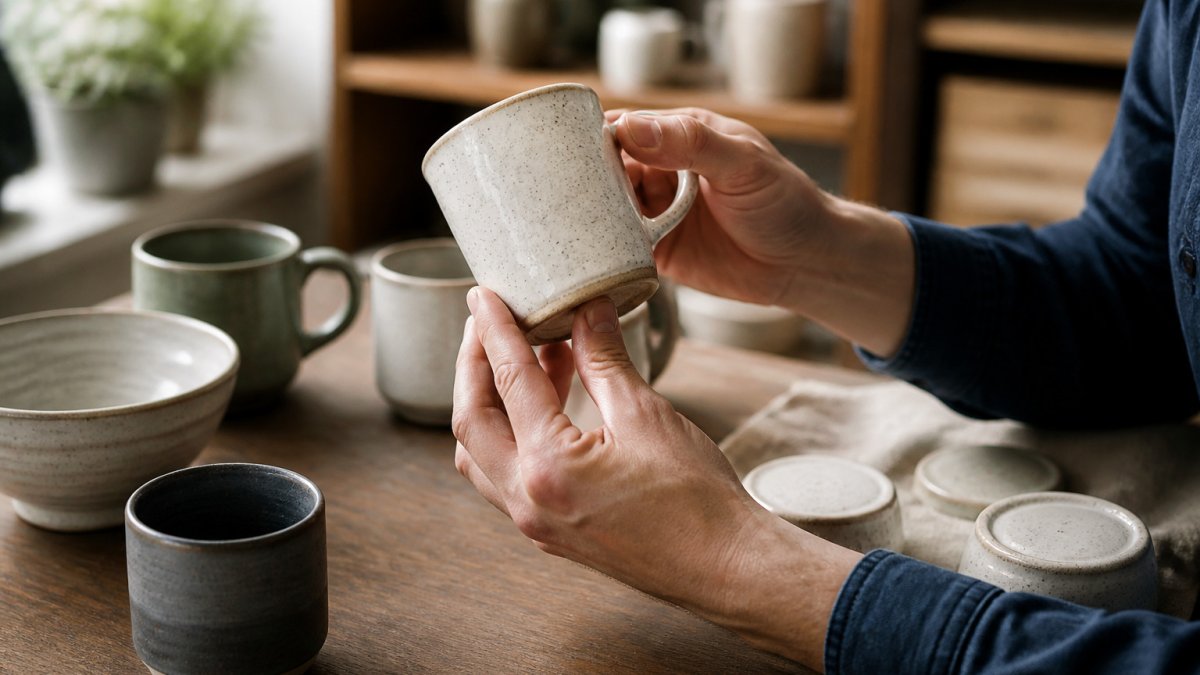
Handle. Slide two fingers through it, not one. A handle that only fits a fingertip forces a pinch grip that gets old by day three. A comfortable handle clears enough vertical and horizontal space for your fingers without forcing a pinch grip.
Base and balance. A curved bottom can look elegant but tip easily.
Weight. A thick ceramic mug feels sturdy and holds heat well, but too thick and a full mug becomes a wrist workout.
The Five-Minute Home Comfort Test
Before you commit, run this sequence. It catches the problems photos hide.
The finger test. Insert two fingers through the handle. If they fit without scraping, the grip works for most hands.
The lip test. Run a fingertip around the rim. Any roughness, burr, or uneven glaze will annoy you daily.
The rock test. Place the mug on a flat counter and press one side of the rim. A stable mug stays planted; a wobbler pivots.
The full-weight test. Fill it with water to your usual pour and lift it one-handed. If your wrist dips, size down.
The knuckle test. Hold the mug as if drinking. The handle should clear your knuckles without forcing your elbow out.
Shape Trade-Offs by Drink
Shape is not cosmetic. It changes temperature, aroma, and pour control.
Tall and narrow: holds heat longer and concentrates aroma, good for black coffee and tea, awkward for latte art because the pitcher spout sits far above the surface.
Wide and shallow: cools faster and gives milk room to settle into a clean pattern, good for lattes and cappuccinos, less ideal for a long black coffee you want hot.
Rounded interior: no sharp corners, so milk and foam swirl cleanly and the mug is easier to rinse.

Judging Artwork Quality and Long-Term Finish Durability
Quality shows up in the details, not the photo. Look at the glaze, the rim, and where the artwork meets the body.
Here is what to check:
Even glaze: no bare patches, bubbles, or pooling on the rim
Crisp edges: artwork lines that stay sharp, not smeared or blurry
Smooth rim: run a finger around it; any roughness will annoy you daily
For a deeper walkthrough, read our guide on how to identify high quality ceramics at home.
Handmade Ceramic Coffee Mugs: What to Inspect Before You Buy
Handmade ceramic coffee mugs carry small variations by design. That is the appeal, but it also means inspecting a few things factory mugs hide.
Weight consistency: handmade pieces vary, but wildly light or heavy spots hint at thin walls
Texture: rough, dimpled, or matte finishes feel great but trap stains more than smooth glaze
Firing cues: look for a clean, even surface and a foot ring that sits flat
Reading Glaze, Texture, and Firing Cues
Glaze is the glassy layer that seals and colors the mug. A well-fired glaze looks even, feels smooth where it should, and shows no cracks. Fine hairline cracks, called crazing, can let liquid seep in over time. Some buyers accept crazing as character; others avoid it for daily use.
Texture is a personal call. Matte and embossed finishes feel wonderful in hand but need gentler washing to keep their look.
Latte Art Cups and Wide-Brim Shapes for Milk Drinks
Latte art cups are built for pouring, not just sipping. A wide brim and a rounded interior give milk room to settle into a clean pattern.
If you make milk drinks at home, look for:
A wide brim so the surface is easy to work with
A rounded interior with no sharp corners
A capacity around 10-12 ounces for a standard latte
One insider note: a mug that is too tall makes pouring awkward, because the pitcher spout sits far above the surface.
Ready to skip the search? Browse our 12oz latte mug for a wide-brim option built for milk drinks.
Microwave-Safe Ceramic Mugs and Material-Specific Care
Microwave-safe ceramic mugs have no metallic trim, no glued-on decoration, and a glaze fired into the clay. Metal accents spark in a microwave, and so can some applied finishes. But food safety and long-term care go deeper than a label on the base.
What Makes a Ceramic Mug Microwave-Safe
Three conditions matter:
No metallic trim. Gold, silver, or platinum bands and rims are the classic spark risk. Even a thin metallic line can arc.
No glued-on or cold-applied decoration. A decal or print applied over a plain mug can contain metallic inks or adhesives that heat unevenly.
A glaze fired into the clay. High-fired glaze is part of the ceramic body, not a coating sitting on top.
If the base carries no microwave-safe label, treat the mug as not microwave-safe until the maker confirms it. Handmade pieces sold without a label are microwave-safe only if the maker says so explicitly.
Food-Safe Glazes and the Lead Question
A food-safe glaze resists leaching and seals the clay body. The concern with older or improperly fired ceramics is lead and cadmium in the glaze or decoration. Regulatory limits for lead and cadmium leaching from ceramicware are set by U.S. agencies, and buyers can ask makers about their testing. You will not see a test report on a shelf, but you can ask:
Does the maker state the glaze is food-safe and lead-free?
Is the decoration under the glaze or on top of it?
Does the maker recommend the mug for daily drinking or display only?
Underglaze decoration, where the artwork sits beneath the glaze layer, is generally considered durable for everyday use.
Crazing: Character or Concern?
Fine hairline cracks in the glaze are called crazing. Some buyers accept it as character; others avoid it for daily use. Crazed glaze can let liquid seep into the clay body over time, which may stain the mug and, in poorly sealed pieces, harbor residue. For a daily driver, favor uncrazed glaze; for display, crazing can be part of the appeal.
Thermal Shock and Sudden Temperature Swings
Thermal shock is the stress a ceramic body feels when one part heats or cools faster than another. Skip sudden swings like freezer to boiling water. A mug from a cold cabinet filled with boiling water is usually fine; one from the freezer is not. Let frozen or chilled mugs come toward room temperature first.
Care Rules by Finish
Glossy glaze: dishwasher-safe on most high-fired pieces; avoid abrasive scrubbers that dull the shine.
Matte and textured finishes: hand wash to protect the surface; matte glaze can absorb oils and stain more readily than gloss.
Underglaze artwork: generally the most forgiving; still avoid abrasive scrubbers on the design.
Dishwasher Compatibility by Material
High-fired porcelain and stoneware: usually dishwasher-safe; check the maker's label.
Earthenware: often hand wash only because the lower firing temperature leaves a more porous body.
Handmade pieces: follow the maker's instructions; many are dishwasher-safe, but textured and matte surfaces wear faster.
For dishwasher questions, our guide on whether ceramic mugs are dishwasher safe covers the details by finish type.
Watch Out A mug that sparks, smells hot, or shows arcing in the microwave is not microwave-safe, even if it was sold as such. Stop using it for reheating and contact the maker.
Key Takeaway Food safety and care come down to three questions: Is the glaze fired into the clay? Is the decoration under the glaze? Does the maker state food-safe and microwave-safe use? If you cannot answer all three, treat the mug as display-first.
Matching Mug Art and Color to Your Kitchen or Dining Room
Color is where most buyers go with gut feel, and that is fine, as long as the mug still fits the room. A few practical rules help.
Pull one color from the room. A mug that echoes a cabinet, backsplash, or rug always looks intentional.
Mix finishes, not chaos. Matte and glossy can live together if the colors agree.
Think about the shelf. A busy pattern disappears in a busy cabinet. It shines against plain shelves.
This is also where personal expression matters most. A one-of-a-kind piece with distinctive artwork makes a daily ritual feel like yours. When you are ready to match color and design to your space, you can browse the full mug selection and see what fits.
Frequently Asked Questions
What should I look for when buying artistic coffee mugs?
Check four things in order: capacity against your usual pour, a rim and handle that feel comfortable, artwork that sits under a smooth glaze rather than on top of it, and care instructions that match your routine. Look for evenly fired ceramic, a flat base that sits steady, and a handle opening wide enough for two fingers. These checks separate mugs that survive daily use from decorative pieces that chip within weeks.
Are handmade ceramic coffee mugs safe for everyday use?
Yes, when the piece is properly fired and glazed. Ask whether the glaze is food-safe and whether the mug is labeled microwave- and dishwasher-safe. Avoid unglazed interiors, rough patches on the lip, and painted decoration that sits on top of the glaze instead of beneath it.
How do I choose the right coffee mug size for my daily coffee?
Use a coffee mug size guide based on what you actually pour. Most home drip and pour-over servings land between 8 and 12 ounces, so a 10- to 12-ounce mug leaves headroom without waste. Espresso and cortado drinkers do better with 6- to 8-ounce cups, while latte and hot chocolate fans should look at 12 to 14 ounces. Measure your current favorite mug first, then match capacity rather than guessing from product photos.
How can I tell whether a mug is dishwasher- and microwave-safe?
Look for an explicit label from the maker, not a general claim on a category page. Microwave-safe ceramic mugs should have no metallic paint, gold leaf, or metallic rim, since those can arc. Dishwasher safety depends on the glaze and any applied decoration. Handwashing extends the life of handmade and artist-designed pieces, especially those with matte finishes or embossed texture, so treat the dishwasher as optional rather than default.
Choosing a mug that looks right and works right takes a little homework, but the payoff is a cup you reach for every morning. At loveUcoffeeMugs, we curate unique mugs, travel mugs, and collectables so coffee lovers can find a piece that fits both their routine and their style. Every order ships free, and sales tax is already included in the price you see. Get started with loveUcoffeeMugs and find the mug that makes your daily brew feel like a small celebration.


Comments